Abstract
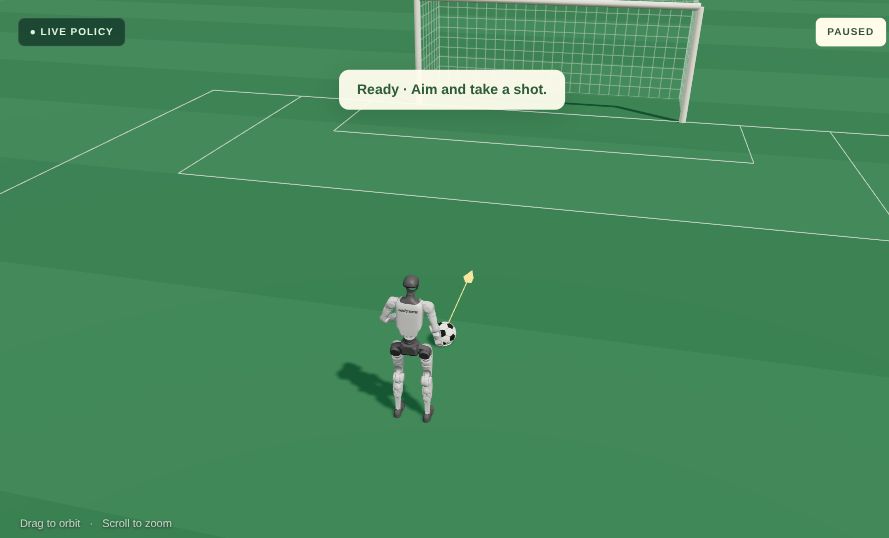
Humanoid soccer requires a robot to seamlessly combine agile locomotion, ball manipulation, and impact-rich contact dynamics across a continuous, dynamic behavioral spectrum. Yet existing approaches either cover only a limited set of skills, or forego motion priors entirely and produce unnatural behaviors, leaving the combination of a unified skill set and human-like motion quality unaddressed. We present SoccerBot, a hierarchical reinforcement learning framework that resolves both limitations through a structured latent motion prior distilled from large-scale human soccer motion capture data. By constraining policy learning within this dynamically plausible motion manifold, a single skill-conditioned policy naturally learns to perform moving, dribbling, trapping, and kicking in a unified formulation, while inherently producing human-like motion and fluid transitions during commanded skill switching. Augmented by robustness-oriented simulation design, SoccerBot transfers zero-shot to the Unitree G1 humanoid robot, demonstrating agile, natural, and robust execution of the full soccer skill repertoire under real-world conditions.
Real-World Deployment
Moving, dribbling, trapping and kicking with one policy on the Unitree G1.
Four Skills, One Policy
Move
Dribble
Trap
Kick
Long-Horizon Tasks
Dribble → Kick
Trap → Kick → Trap
Method
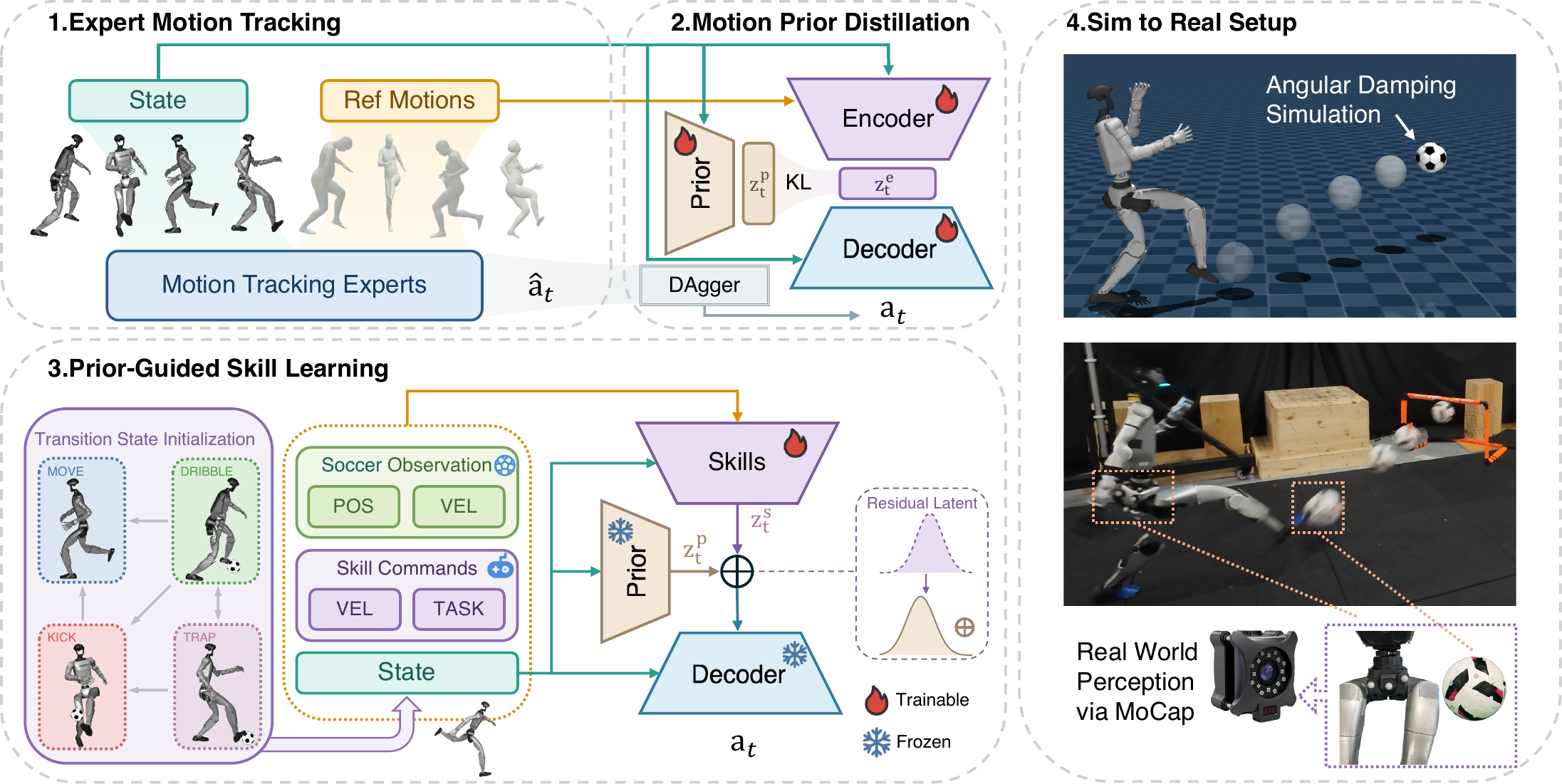
SoccerBot separates low-level motor competence from high-level soccer task optimization in three stages.
-
1
Expert Motion Tracking
Human soccer demonstrations are retargeted to the G1 and filtered with a physics-in-the-loop pipeline, yielding about 2.5 hours of feasible reference motion. A whole-body tracking policy is trained with RL to imitate them.
-
2
Motion Prior Distillation
The tracking expert is distilled into a variational encoder–decoder with a proprioception-conditioned prior. The prior and decoder are then frozen as a reusable latent motion space.
-
3
Prior-Guided Skill Learning
A single skill-conditioned policy adds a learned residual to the prior latent. The frozen decoder maps the combined latent to joint position targets. Transition-state initialization supports robust switching among move, dribble, trap, and kick.
Four Skills in Simulation
One skill-conditioned policy performs all four skills. Each video compares low, medium, and high speeds from left to right.
Move
Trap
Dribble
Kick
A Closer Look in Simulation
Footage in slow motion shows how SoccerBot positions its feet to strike the ball and control an incoming pass.
Inside-foot kick
Receiving a pass
Writing with the Ball
Four robots take turns tracing “CORL” with the ball, one letter each. Every handoff connects a kick, a reception, and the next dribbling sequence.
Four robots, one word
BibTeX
@inproceedings{shao2026soccerbot,
  title     = {Playing Soccer Like Humans Do: Learning Versatile and Agile Humanoid Soccer via Latent Motion Priors},
  author    = {Shao, Haoyu and Wang, Yunshen and Zhang, Jingze and Zhu, Shaohang and Li, Yong-Lu and Zhang, Tianzhu and Jia, Baoxiong and Huang, Siyuan},
  booktitle = {Conference on Robot Learning (CoRL)},
  year      = {2026},
  url       = {https://arxiv.org/abs/2611.06564}
}